Early diagnosis and a treat-to-target strategy using composite disease activity scores, a stepwise DMARD algorithm, and screening for comorbidities and vaccination.
Covering the full spectrum of rheumatic & musculoskeletal disease
Rheumatoid Arthritis Systemic Lupus Erythematosus Osteoarthritis Gout & Crystal Arthropathies Ankylosing Spondylitis Psoriatic Arthritis Sjögren's Syndrome Systemic Sclerosis Myositis Vasculitis Fibromyalgia Soft Tissue Rheumatism

Rheumatology Newsletter
News Rheum — Volume 5 No 2
December 2024 · Special Edition · 24 pages
The latest 24-page edition of News Rheum, the official newsletter of the South African Rheumatism and Arthritis Association — news, clinical updates, and event reports from the rheumatology community. Read it online or download the PDF to share with your team.
Evidence-based practice
Clinical Guidelines & Downloadable Resources
The South African Rheumatism and Arthritis Association (SARAA) 2024 guidelines, published in the South African Medical Journal and co-authored by members of the UCT Division of Rheumatology. Open access — free to download and share with your team.
Screening tools, imaging, and investigations for axSpA, with a multidisciplinary approach, ASDAS-based disease activity monitoring, and a stepwise therapy algorithm.
Diagnosis, assessment, and treat-to-target therapy of psoriatic arthritis, IBD-associated arthritis, reactive arthritis, and undifferentiated peripheral SpA.
Choosing and monitoring b/tsDMARD therapy, safety and vigilance for adverse events, and enrolment in the SARAA biologic registry.
Reproduced from the South African Medical Journal under the Creative Commons BY-NC 4.0 licence.
Educational publications
Handbooks & Publications
Handbooks and reference guides available for purchase from the Division of Rheumatology — practical references for clinicians and trainees managing rheumatic and musculoskeletal disease.
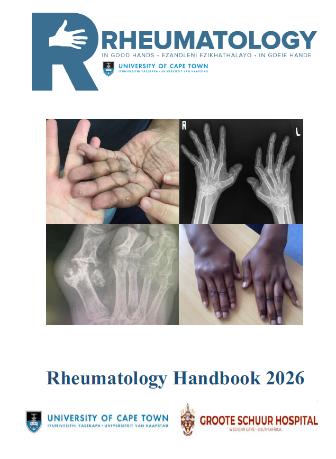
Rheumatology Handbook
Approaches to diagnosis and management of musculoskeletal problems.
R300
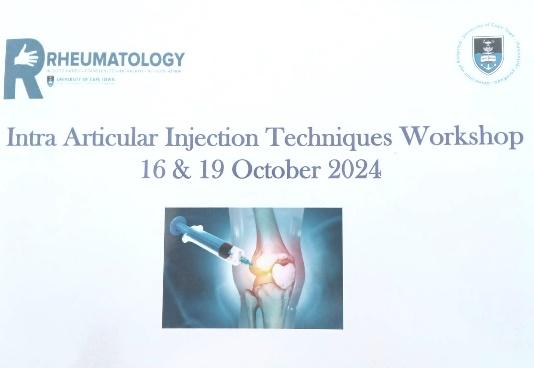
Intra Articular Joint Injection Booklet
A practical guide to intra-articular joint injection technique, produced for the division's injection techniques workshop.
R100
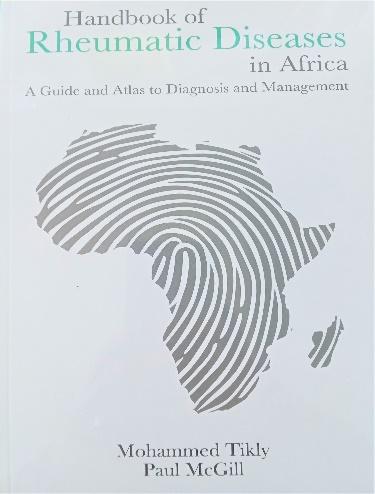
Handbook of Rheumatic Diseases in Africa
A guide and atlas to the diagnosis and management of rheumatic diseases in the African context.
R600
How to order
Available from Mrs Amelia Lawrence, Room 47, J floor, Old Main Building — or email to order.
Email to purchase →"The gap between academic rheumatology and the frontline clinician is exactly where our patients suffer most. We're here to close it."Division of Rheumatology, University of Cape Town
On-demand learning
Recorded Seminars & Lectures
Watch at your own pace. Our library of recorded teaching sessions covers clinical presentations, diagnostic approaches, and management updates — presented by UCT rheumatologists and international experts.
Biologics Masterclass
TNF Inhibitors
An introduction to tumour necrosis factor inhibitors in rheumatic disease — how they work, which patients are suitable, and what to monitor once therapy has started.
▶ Watch nowBiologics Masterclass
Rituximab, Abatacept, Tocilizumab and Belimumab
A survey of the non-TNF biologics — their mechanisms of action, the conditions each is used for, and the practical considerations that guide choosing between them.
▶ Watch nowBiologics Masterclass
IL-17, IL-12/23 and IL-23 Inhibitors
The interleukin pathway inhibitors and their place in managing psoriatic arthritis and axial spondyloarthritis, including how the different targets compare in practice.
▶ Watch nowBiologics Masterclass
Access to Biologics: The Funder Landscape
How biologic therapy is funded in South Africa, and what clinicians need to know when motivating for access — covering the funder environment and how to build a persuasive motivation.
▶ Watch nowBiologics Masterclass
JAK Inhibitors
Janus kinase inhibitors in inflammatory disease — mechanism of action, where they sit alongside biologic therapy, and the safety monitoring their use requires.
▶ Watch nowMedilearn Lecture
Gout: What's New
An overview of gout and its rising prevalence — modern diagnostic criteria, managing acute flares, and long-term urate-lowering therapy, including drug interactions and emerging treatment options.
▶ Watch nowLive learning
Upcoming Online Engagements
Live webinars, case discussions, and Q&A sessions hosted by the UCT Division of Rheumatology — free for registered healthcare workers in South Africa.
Live sessions coming soon
We are planning our next series of live webinars, case discussions, and Q&A sessions. Dates and registration details will be announced here.
When and how to refer
Referral Pathways
Not every patient with an RMD requires specialist input — but knowing when and how to refer is critical for optimal outcomes. The UCT Division of Rheumatology accepts referrals from GPs, nurses, physiotherapists, and other healthcare professionals across South Africa.
-
Identify the need for referral
Use the referral criteria alongside to determine whether a patient warrants urgent, routine, or non-urgent rheumatology review.
-
Prepare the referral letter
Include the clinical history, relevant examination findings, current medications, and investigation results (FBC, CRP/ESR, RF/anti-CCP where available). A clear clinical question helps us prioritise appropriately.
-
Submit your referral
Referrals to the UCT Rheumatology outpatient service are made through Groote Schuur Hospital via the standard Western Cape referral system. See contact details below for the correct channel for your region.
-
Continue co-management
Most patients are best managed in a shared-care model. Our team provides specialist advice, adjusts therapy as needed, and works with you to ensure continuity of care in your practice.
When to refer to rheumatology
- Suspected inflammatory arthritis (swollen, warm joints with morning stiffness >30 min)
- Positive RF, anti-CCP, or ANA with clinical features of connective tissue disease
- Multi-system disease with rash, serositis, nephritis, or haematological abnormalities
- Suspected SLE, myositis, vasculitis, or systemic sclerosis
- Inadequate response to initial DMARD therapy or NSAID management
- Recurrent or tophaceous gout unresponsive to urate-lowering therapy
- Diagnostic uncertainty with inflammatory markers and joint involvement
- Consideration of biologic or biosimilar therapy
Urgent referral: Any patient with suspected systemic vasculitis, acute organ involvement (renal, cardiac, pulmonary), or rapidly progressive inflammatory disease should be referred urgently or discussed by telephone.
Get in touch
Professional Queries & Contact
Whether you need clinical advice, have a question about a patient, want to discuss a referral, or would like to arrange a teaching session for your team, the division is here to support you.